





NORA520

Overview
Mechanism of Action
Advantages over Approved Drug
Indications
Clinical Development
Overview
NORA520 is an oral prodrug which is hydrolyzed to Brexanolone (same chemical structure of endogenous allopregnanolone), the same active ingredient in the only FDA-approved drug specifically indicated for postpartum depression (PPD). NORA520 provides an alternative convenient oral treatment to PPD patients and it potentially can become the first line therapy.
In addition to PPD, NORA520 is also being developed for Major Depressive Disorder (MDD), with the goal of delivering alternative therapeutic option that offers patients a new treatment experience.
Mechanism of Action
Allopregnanolone, a metabolite of progesterone, is an endogenous neuroactive steroid. Lower level of allopregnanolone is associated to postpartum depression. Allopregnanolone is one of the most potent extrasynaptic GABAA receptor modulators, and GABAergic dysfunction is closely related to the etiology of PPD. The active moiety of NORA520, which is structurally identical to allopregnanolone, binds to extrasynaptic GABAA receptor and increases tonic GABAergic current.
- Hellgren et al. Neuropsychobiology. 2014;69(3):147-53
- Osborne et al. Psychoneuroendocrinology. 2017 May;79:116-121
- Meltzer-Brody et al. Neurobiol Stress. 2020 Feb 3;12:100212
Advantages over Approved Drug
NORA520 has various advantages over the FDA-approved drug specifically indicated for PPD and current standard of care and allows for a much-improved patient experience. NORA520 is manufactured as an oral tablet, allowing for potential outpatient administration. The design of the prodrug NORA520 can overcome the difficulties and inconvenience of the current 60-hour IV infusion treatment regimen of the FDA-approved drug specifically indicated for PPD; at the same time remains the advantage of rapid onset of action, short treatment duration and same efficacy durability.

Oral administration

MOA leads to rapid onset of action

Brief treatment duration

Potential outpatient administration

Avoid AEs caused by infusion pump malfunction
Indications
Postpartum Depression
Postpartum depression (PPD) affects some women after childbirth and can cause considerable suffering, not only for mothers, but also for their close family members. It has been reported that 121 million women are affected globally. In the US, about 50-80% women experience the “baby blues” each year, which includes still births and miscarriages, and 450,000 mothers are diagnosed with postpartum depression.

Postpartum Blues
(“Baby Blues”)
- Occur in 50-80% of new mothers
- Symptom length <2 weeks
- Do not impair maternal function

Postpartum Depression
- Symptoms occur almost daily and may result in functional impairment
- Occur in 10-20% of all women
- Symptom length could be several months to one yea

Postpartum Psychosis
- Occur in 0.1-0.2% of birth
- Symptom are temporary but must be treated
- Mental health emergency putting both mother and child at risk
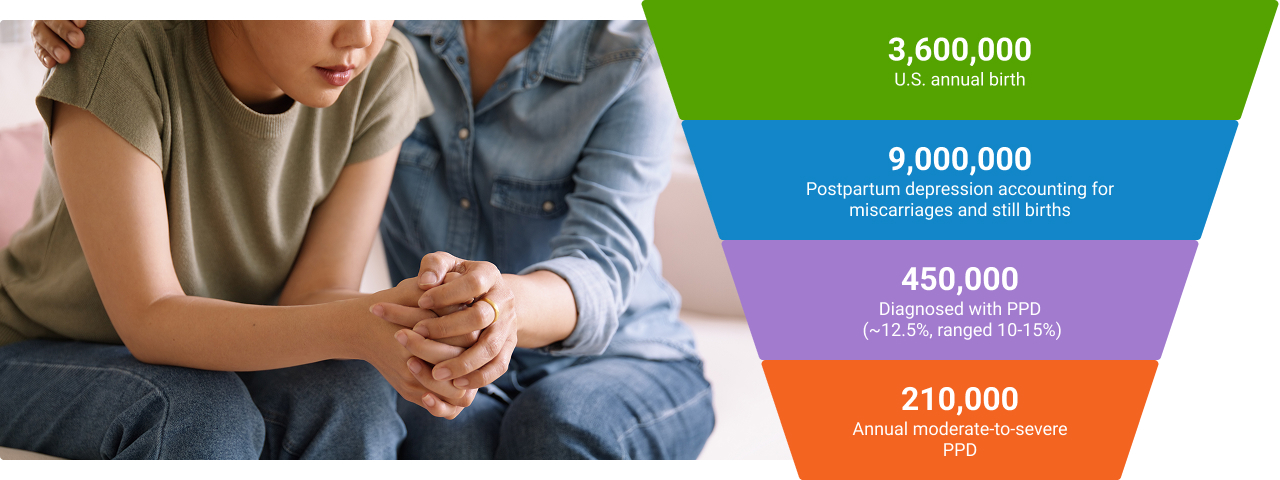
- CDC.gov; UpToDate, accessed Jan. 2022
- Langdon, K. Postpartum depression statistics. 2022, retrieved from postpartumdepression.org
- Postpartum Depression: Action Towards Causes and Treatment (PACT) Consortium. Lancet Psychiatry. 2015. 2(1):59-67
- Shorey et al. J PsychiatrRes. 2018. 104:235-248
- Shidhaye PR and Giri PA. Ann Med Health Sci Res. 2014 Jul-Aug; 4(4): 463–465
Major Depressive Disorder
Major Depressive Disorder (MDD) is a common mental health condition that not only causes prolonged periods of extreme low mood, but also affects thinking, behavior, and physiological functions, severely disrupting daily life and work. It is more than just feeling down; it is a medical condition that requires professional care.

Mild Depressive Disorder
- Symptoms are minimal, and daily functioning is usually barely maintained.
- Duration is relatively short, with no serious interference in daily life.
- Predominantly low mood, with mild physiological symptoms.

Moderate Depressive Disorder
- Symptoms are moderate in number and intensity, with noticeable impairment in daily functioning.
- Difficulty maintaining work performance or academic achievement.
- Emerging significant fatigue, sleep disturbances, or appetite changes.
Major Depressive Disorder (MDD)
- Symptoms are severe, persistent, and interfere with the ability to carry out daily activities.
- Often accompanied by pronounced psychomotor retardation or agitation.
- May involve recurrent thoughts of death or suicide.
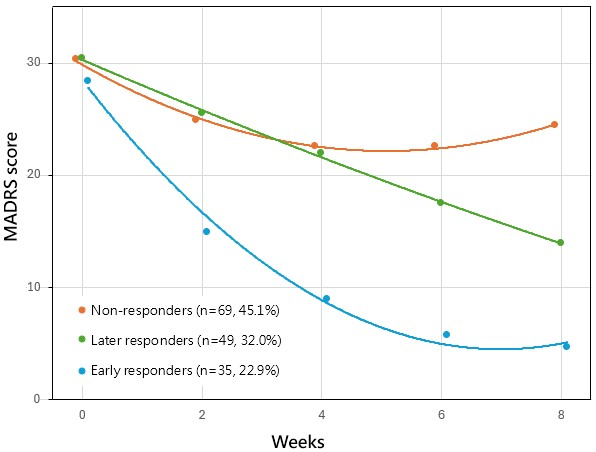
Limitations of Traditional Antidepressants
- Over 30% of patients with Major Depressive Disorder show no response to traditional antidepressants (with little or no improvement observed at any assessment point during the trial, or only transient improvement during the early phase of the study).)
- Among patients who respond to traditional antidepressants, over half experience a slow onset of effect (taking more than 2 weeks).
- Modified from Laura et al. Transl Psychiatry . 2021 Aug 21;11(1):439, Fig. 1
Clinical Development
- NORA520-PT-US-1a is a Phase 2 clinical trial to test the study drug, NORA520, as a possible treatment for severe postpartum depression (“PPD”).
- The U.S.-based Phase II clinical trial of NORA520 for the treatment of postpartum depression (PPD) has obtained the statistical results for the primary efficacy endpoint. The difference between the treatment groups and the placebo group did not reach statistical significance. (For more information, please refer to the press release published on our company website on November 16, 2025.)
Details of NORA520 clinical trials: www.clinicaltrials.gov